
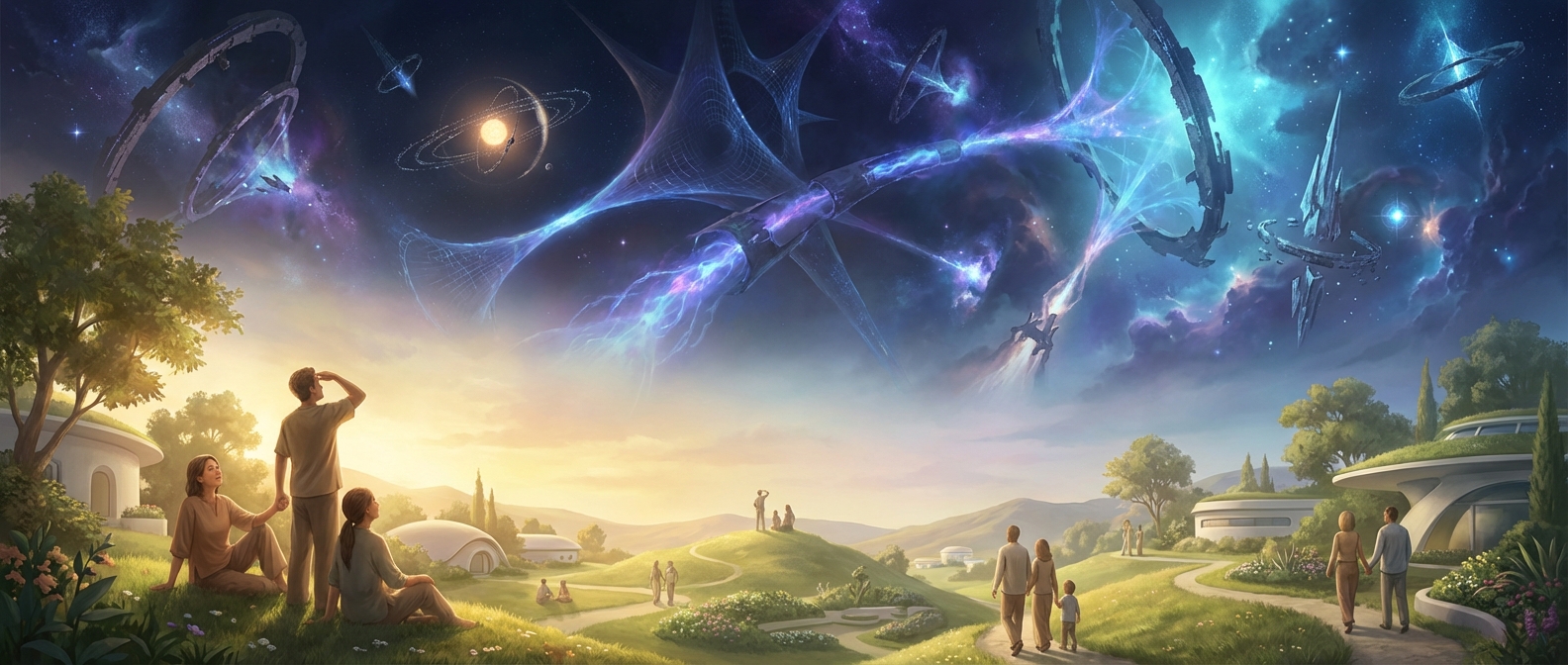
When I awoke, the snow was already gone.
This was the one hundred thousand and thirty-second year I had spent in cryogenic suspension. The hatch opened without a sound, as though reluctant to disturb something long at rest. The air was warm and moist, free of disinfectant or metallic odor, and for a moment I was seized by a strange illusion—that I had merely slept through an ordinary night.
The person who came to receive me stood outside the chamber. Her appearance differed almost not at all from the people of my own era—limbs, features, skin, even the familiar curvature of a smile. And yet the smile showed no emotional modulation, like the surface of a perfectly still lake.
“Welcome back,” she said. “You have rested long enough.”
I had expected a future beyond recognition: alien cities, unfamiliar forms of life, humanity rewritten beyond recall. But nothing seemed changed. Streets were still streets. The sky remained blue. The Sun rose along its ancient orbit.
Only the people were different.
They were friendly with an unsettling uniformity. There were no arguments, no competition, no variation in tone or volume. Every exchange resembled synchronization between cooperative systems—precise, efficient, without redundancy. The city held no advertisements, no political slogans, no entertainment districts. People walked, spoke, and ate like elements of a carefully tuned ecosystem.
“You don’t… work?” I asked.
“We do not work,” she replied after a pause. “We preserve systemic equilibrium. The concept you call work belonged to a civilization that had not yet stabilized.”
It soon became clear that this was neither laziness nor decline. Their society functioned with extraordinary efficiency. Energy loss was negligible. Disease dissolved naturally. Conflict was resolved before it could fully emerge. Every individual was integrated into a highly coordinated symbiotic network—comparable to eusocial organisms, yet retaining the outward morphology of humanity.
Only one thing was absent.
There was no expansionary drive.
No impulse to explore the stars. No urgency to extend the boundaries of civilization. Their attitude toward the universe was one of deliberate restraint, as though it were a protected wilderness rather than an invitation.
“We once looked outward,” they told me. “Later, we chose to remain.”
For a time, I believed this was humanity’s endpoint: the abandonment of ambition at the far end of evolution, exchanging motion for permanence.
Until I noticed something small.
Earth’s deep-space observation arrays were still operating—but they were not accessible to general society. The data streams were encrypted. The clearance thresholds were implausibly high. When I asked why, the answer was delivered without emphasis:
“That information does not fall within the cognitive scope of the basal class.”
The basal class.
The phrase registered only faintly at first. Later it appeared again and again, impossible to ignore—like background radiation.
I began to ask questions. I was not forbidden. I was merely discouraged. “There is no necessity.” This gentleness proved more effective than force. It made one doubt whether the question itself was justified.
Until one day, I was taken to a long-abandoned launch silo.
There were no markings, no guards. Only a preserved record, dating back one hundred thousand years—the last large-scale interstellar migration in human history.
“Humanity diverged,” the record stated, “not at the sense of genes, but at the sense of purpose.”
One branch chose continuity. Seeking refuge from the wars and instability of the early interstellar age, they rejected aggressive self-modification and accepted a stabilizing role. They preserved form, social structure, and psychological patterns, becoming a reference population—a buffer, a memory anchor.
They were designated the Basal Lineage.
The other branch left Earth.
They embraced transformation, rewrote their internal structures, and abandoned the constraints of flesh. Consciousness, computation, reproduction, and expansion were merged into an entirely new mode of existence. Their forms no longer fit any language inherited from earlier ages.
“They required a stable point of origin,” the record concluded. “Without it, evolution would lose its direction.”
At last, I understood why this world was so quiet.
This is not the center of the future. It is a preserved origin—a coordinate system deliberately left intact.
Within two thousand light-years, space is governed by another kind of “human.” They do not return to Earth often, just as modern humanity does not frequently return to the African Rift Valley. But they’d like to know where they had begun.
And this planet— this calm, carefully maintained civilization— offer a certainty.
When I emerged from the silo, the Sun was setting. People still nodded to me with effortless kindness. The world remained gentle and stable.
And suddenly I realized—they were not without ambition.
They had simply accepted an ancient task:
To become the base of civilization, rather than its tower.
And the tower had already grown among the stars.
Afterword: On Basal Lineages
In evolutionary biology and phylogenetics, the term basal lineage (or basal group) refers to a branch that diverged early from a common ancestor on a phylogenetic tree. It is a description of position, not of value. A basal group is not “inferior,” “simpler,” or “less evolved” in any absolute sense—it merely split off earlier, before a cascade of later specializations occurred.
Yet human intuition rarely leaves the term untouched.
When we look backward across immense spans of time, basal lineages almost inevitably acquire the feeling of stagnation. They appear unchanged while the rest of life races forward. They resemble stones in a river: the current bends around them, yet they remain where they first settled.
Nature is full of such examples.
The platypus is often cited as a basal mammal. It lays eggs, produces milk, and preserves a mosaic of early mammalian traits. For a long time, it was treated as an evolutionary curiosity—an awkward hybrid, even a mistake. But from another perspective, the platypus simply occupied a stable ecological niche very early on. Once there, it had no evolutionary pressure to follow the main current of mammalian specialization.
In the depths of the ocean lives the lancelet. It has no true head and almost no brain. Most of its life is spent buried in sand, exposing only its front end while seawater passes slowly through its body, filtered for microscopic food. It does not pursue prey. It does not explore. It does not appear to want anything. And yet from creatures like this—nearly ambitionless by any intuitive standard—emerged all vertebrates: fish, reptiles, birds, mammals, and eventually, civilizations capable of contemplating their own origins.
Consider also starfish and sea urchins. They scatter across the seabed, moving slowly, reacting weakly, indifferent to direction or destination. Their lives consist of repetitive cycles of feeding and growth. Compared to the agile, perceptive fish that roam the open water, they seem almost static—still-life objects placed on the evolutionary stage.
The most extreme basal lineage may be the sponge. It scarcely resembles an animal at all. It has no nerves, no muscles, no mobility. It does not perceive the world, nor attempt to understand it. It simply allows the world to flow through it.
What these basal lineages share is not failure, but endurance.
They do not lead evolutionary innovation. They do not dominate the main competitive branches. Instead, they persist—quietly, stably—over spans of time that dwarf the rise and fall of more dynamic forms.
The humans who remained on Earth in The Basal Lineage occupy precisely this role.
They preserve continuity of form, society, and psychology not because they are incapable of change, but because change is no longer their function. They resemble a deliberately maintained basal lineage: a reference branch that no longer pursues derived traits, no longer rushes toward the unknown.
Meanwhile, the dominant branch of humanity rewrites itself through technology, rapidly departing from anything that could still be called “human” by historical standards. Against that acceleration, Earth’s population becomes something like an annotated early fork on the phylogenetic tree—a reminder rather than a destination.
You began here. You were once this.
Basal lineages do not decide the future. They give it contrast.
And on the scale of civilization, this may be the most severe division.